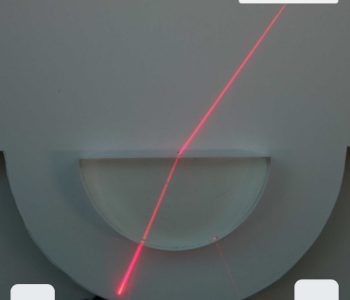
This is an image from an actual lab experiment to demonstrate refraction and total internal reflection of a laser beam in glass.
But it is more than that: it is NOT an animation — it is a real experiment in a real optics lab, documented by hundreds of photographs which operate interactively under the user’s control.
Repeat: none of this is simulated.
To have a go with the real experiment click on the ‘START EXPERIMENT‘ button below.
Following the public interest created by the movie The Imitation Game, starring Benedict Cumberbatch and Keira Knightley,FA publications was approached to create a full photorealistic simulation of the M4 version of the Enigma encryption machine of the type used by the Kriegsmarine submarine wolf pack in World War II. It is this machine that produced the Shark encrypted messages that were broken by the codebreakers at Bletchley Park.
Click on the ENIGMA button below if you want to learn more about this machine and to have a go at enciphering and deciphering your own messages.
This project was built in order to demonstrate the power of HTML5 and in-browser JavaScript in animating a virtual jigsaw within a multimedia environment, including sound and video.
Static Screenshot
Click/tap the violet “DO JURASSIC PUZZLE” button below to try your hand at this 24-piece puzzle. It’s not as easy as it looks. Afterwards, use your browser back button to return to the Portfolio screen.
We’re sure you’ll be able to work out for yourself how to manipulate the jigsaw pieces (both movement and rotation).
Reading Mencap, a small local charity based in Reading, Berkshire, wanted to celebrate its gaining the coveted Safe and Sound Award for high-quality governance and safeguarding. So FA Productions designed this little bit of HTML5 for its website to do that. It looks like an innocent little static image, but there’s an Easter Egg in there that will produce some movement and sound, if you can find it (obviously, best appreciated with sound enabled).
The HTML5 code uses JavaScript, a client-side programming language that is built into every modern browser. So the code is downloaded to your device with the web page, and your device runs the program to create the animation. There is no significant load on the server.
Kids will be kids, even when they’re adults. This is a game devised by FA productions at the request of a group of parents who were getting sucked into teaching their kids about computer coding. The platform is SCRATCH, a visual programming medium devised by MIT (Massachusetts Institute of Technology). It’s free to use and appeals to kids even as young as six. It’s used in lots of schools for simple applications.
SPOT THE TUNE is a game where you have to identify one of the moving characters on the screen with the theme tune from a children’s TV programme shown in the UK when the parents were children themselves. All you have to do to score is to click/tap on the correct character. And then repeat for several times. It’s harder than it looks — the characters move about a lot, and some of the the tune clips are quite short.
Click/tap the green flag on the screen image below when you’re ready to begin.
The Alexa Echo Show from Amazon is a massive benefit to elderly people living isolated lives. Some of its uses are obvious, but research by FA productions reveals powerful opportunities that are largely unknown to the general public. Many of these features are very easy to implement and are massively beneficial to both the elderly person and their remote relatives. What’s more, they all free, and can be implemented remotely, without any input from the elderly person, who just asks Alexa by voice for whatever he or she wants. FA productions is pleased to present these opportunities to a wider public in this detailed project.
Click/tap the green BEGIN button below to see lots more information, including a short slide presentation.
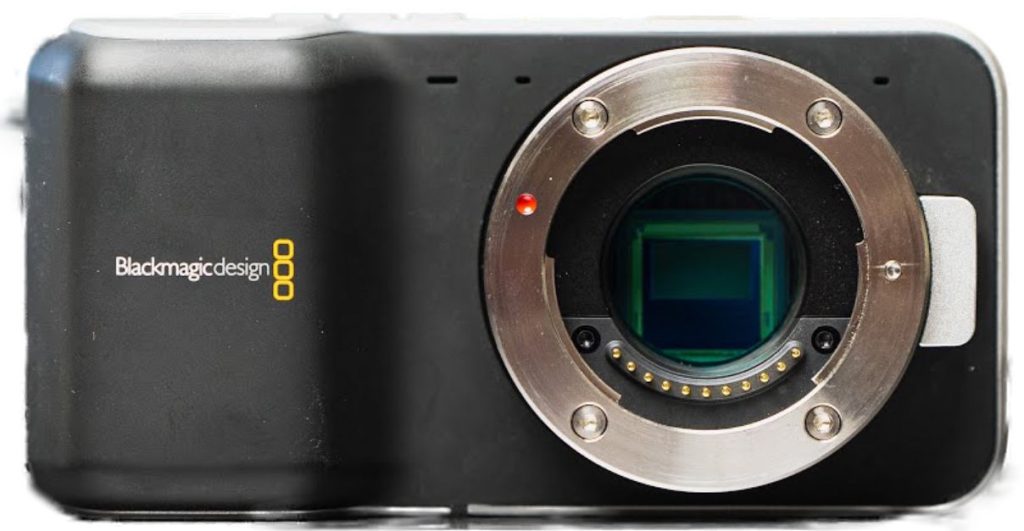
The original Black Magic Pocket Cinema Camera (BMPCC — the 1080p HD version) is not made any more. Nevertheless, it’s still available used from eBay etc for about £500 upwards, and it represents a great introduction to the field for those interested in dabbling in serious video production. Provided that is, you are content with its dedicated 16×9 full HD format of 1080p (1920 by 1080 pixels).
The BMPCC is a true cinema camera. It won’t shoot stills and it won’t deliver ready-to-view footage unless you’re keen to restrict yourself to low-contrast desaturated shots. No! BMPCC footage in Apple ProRes format will require post-editing in Final Cut Pro or Da Vinci Resolve or Adobe Premier Pro, or similar, before it’s ready to be revealed to the public.
OK, so you might see that as a problem, but, in fact, it carries lots of advantages with it.
And, while we’re seeing problems, why not continue for a while in that vein by talking about the things about this camera that are a pain in the bum. And then, eventually, we can get on to why, despite all of that, it’s still a great camera to have.
Cons …
For a start, its battery life is a joke. You’d better have a pocketful of fully charged replacements if you’re out and about. Fortunately, they’re readily available and as cheap as chips. Or you can easily plug in an external battery with more oomph — again, they’re readily available. But that increases the overall size of your kit, of course.
Its autofocus is unreliable and better avoided.
It can run pretty hot (this is probably related to the first point above) — useful for keeping your hands warm on a cold winter’s day, and I’ve never known it shut down or fail due to overheating.
There is no eye-level optical viewfinder — just a very large high-quality monitor screen on the back face of the camera. That’s excellent as far as it goes, but … you have to hold your head about a foot away from the camera in order to be able to focus your eyes on it, and, in bright sunlight, you’ll have difficulty in seeing it clearly unless you rig up some sort of shade.
Its image format is a 16×9 version of the old semi-professional film movie format Super-16 (12.48x 7.02 mm, that is a 14.32 mm diagonal on 16×9). So that’s a crop factor of 3 compared to lenses for a conventional full-frame 35mm film camera, whereas most other MFT-mount cameras will have a bigger sensor (a so-called four-thirds sensor) running at a crop factor of about 2. Thus, a lens with a 16.7 mm focal length on the original 1080p BMPCC will match the field of view of a 50mm lens on a full-frame 35mm camera, or a 25 mm lens on most MFT cameras. Clearly, this is a small image sensor, but remember it’s operating at 1080p HD, not UHD, so its image quality is fine for most applications. And, just to set sensor size in context, the “1-inch CMOS sensor” on the DJI vlogging camera Osmo Pocket 3 actually has a diagonal hardly bigger than the BMPCC (maybe 15.9 mm cf 14.3 mm)
Pros …
It’s really small and light compared to most specialist video cameras. It’s significantly smaller than later BMPCC cameras (the 4K and 6K). You really can put it in your pocket, especially if you fit it with a low-profile 12mm semi-wide-angle lens. I’ve shot a whole wedding in this way.
The Apple ProRes recording format gives the camera a dynamic range of up to 13 stops, so you don’t need to fuss about getting the exposure just right, even in very dim light. You’ll almost always be able to extract good quality footage from whatever you shoot. This is a very valuable property.
Its MFT lens mount means you have access to a vast range of lenses, and all of them much cheaper and lighter and smaller than lenses with a bigger mount (there’s less glass!). So you don’t have to save up for months or years to buy each lens. This massively increases your creative possibilities. You can cheaply explore focal lengths from fisheye to long telephoto at a fraction of the equivalent cost for a full-frame camera.
MFT lenses are normally designed for the MFT image format. The original BMPCC 1080p image format is smaller (see above). That means you’re not using the edges of the image that the lens is designed to deliver. And it’s at the edges that the image quality falls away (even with the highest quality lenses), so, overall, you’re getting better quality images than typical MFT cameras using the same lens (including the BMPCC 4K).
It’s hard to believe, but you eventually get to like the restrictions imposed by this camera — you sort of feel you’re in control, and not the camera software. Back to basics!
Sensor size and depth of field (a cautionary note)
Sensor size does more than affect the crop factor in the field of view. It also indirectly affects the depth of field. That’s because a smaller sensor size will require a shorter focal length lens to cover the same field of view as a camera with a larger sensor. And the depth of field for a given f-number is linked to the longitudinal magnification of the lens. And the longitudinal magnification goes as the focal length squared. So a ‘standard’ lens on a conventional old-school 35mm film camera will have four times the longitudinal magnification of a lens with the same fov on a typical MFT camera, and nine times that of the equivalent fov lens on a BMPCC original. so, if those three camera:lens combinations are all working at the same relative aperture (say f/2), the image formed by the 50mm lens on the 35mm film camera might show a lovely shallow depth of field, whereas the equivalent 17mm lens on the original BMPCC might show the whole object depth in reasonable focus. This effect is always present. Unless the image is processed to imitate shallow depth of field, it’s even worse for phone cameras, which typically have a “1x” fov roughly equivalent to a 25mm lens on a 35mm camera. So big cameras still have their place if you’re looking for shallow depth of field.