ENIGMA MACHINE
Enigma was an electromechanical encryption machine used by the Germans in WW2 — see the 2014 movie THE IMITATION GAME, with Benedict Cumberbatch and Keira Knightley (which doesn't quite meet the tough challenge of delivering a mixture of a biography of Alan Turing and a thriller), or (better) the 2001 movie ENIGMA (Tom Stoppard's screenplay of Robert Harris's book — how could that combo fail?), with Dougray Scott and Kate Winslet.
At the heart of Enigma was a scrambled electrical wiring system that connected each letter of the alphabet to a different letter. So pressing the E key, for example, might illuminate the S bulb. The operator would type in the plaintext message and a colleague would note down the illuminated letters as they appeared one by one, and afterwards the encrypted message would then be transmitted by radio, using Morse Code.
This encryption technique is known as alphabetic substitution and, although the number of possible letter pairings is very large, if that were all there was to Enigma, then its encryption would be pathetically easy to break, except for very short messages, simply by making use of the statistical frequencies of individual letters and letter sequences in German texts.
So Enigma wasn't just that. The alphabetic swap pairing of letters was entirely changed each time a key was pressed.

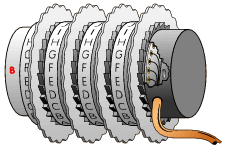
This was achieved electromechanically, by routing an electric current back and forth through a set of rotors (see drawing and photo above), at least one of which clicked round a step with each keypress. The act of pushing down a letter key on the keyboard (lower part of photo above) would first advance a rotor (to re-jumble the aphabetic pairings) and then conduct a current from the battery via the key contact out and back again to the contact for a different letter, and through that to the lamp for that letter, which would then illuminate (middle part of photo above). The Germans believed that changing the letter jumbling pattern for every character of the message would make Enigma cipher text completely unbreakable.
Because of its letter-pairing electrical circuit, Enigma cipher text was reciprocal: typing the encrypted message on a machine with the same initial settings as were used to do the encryption would decrypt that message into plaintext.
For the same reason, it was impossible for a letter to be encrypted as itself. This apparently insignificant property of all Enigma messages was vital in the breaking of Enigma at Bletchley Park.
It was essential that the initial settings of the machine (the key) were known to the person receiving the message. This is another weakness of Enigma: how to deliver securely to the receiver what key must be used to decrypt the message created by the sender? This was done mainly by codebooks supplied each month. Codebooks were usually printed with water-soluble ink, and Enigma operators were advised to have a bucket of water to hand into which they could plunge the codebook if capture was imminent.
A third weakness was the sloppiness of some Enigma operators, who might often begin their messages with the same greeting phrase or other predictable text.
OK, that's enough chatty background. So FA productions has built (using the JavaScript that is part of your web browser) an accurate photorealistic simulation of the real Enigma M4 machine.
This is the Enigma machine with an added 4th rotor. It was deployed by the Kriegsmarine submarine wolf pack from 3 February 1942, causing an immediate decryption blackout at Bletchley Park that lasted for eight months.
So .. on to the initial settings ... in the current version of the simulator, We've simplified things by fixing for you several of the variables: the choice of rotors and in what order they are (Walzenlage:
The only part of the initial settings left for you to set are the initial rotor positions (the Grundstellung) — these are the letters that should appear in the rotor windows when you switch on the machine, ready to encrypt/decrypt a message. The Enigma photo above shows a Grundstellung of ABCU.
You change the Grundstellung of a rotor by tapping on its thumbwheel (up or down — look back at the image above). Do this before you switch on the machine — the Grundstellung are locked after switch-on.
How do you switch on the machine? I'll leave that to you to discover.
NB: Sorry, but this simulation will not work on a phone — it requires a bigger viewport than any phone can provide. Use an iPad or a laptop or a desktop.
I've included on the browser screen two Kriegsmarine notepads for your convenience: the one on the left records what text you type; the one on the right records the decryted or encrypted version of that.
When you type to encrypt or decrypt, you'll notice that there are no spacebar or punctuation symbols — this was to keep the rotor design simple. The Germans often used X to indicate a space or a full stop.
There's no delete key so, if you mess up, you need to begin again — just reset the machine back to the starting point by reloading the page in your web browser.
Are you ready to run the Enigma M4 simulation? Sure? Got the message ready that you need to encrypt/decrypt? Got the specified Grundstellung?
OK, then, USE THE ENIGMA MACHINE OR
RETURN to Portfolio