 1
1
Black Magic Pocket Cinema Camera
The original Black Magic Pocket Cinema Camera (BMPCC — the 1080p HD version) is not made any more. Nevertheless, it’s still available used from eBay etc for about £500 upwards, and it represents a great introduction to the field for those interested in dabbling in serious video production. Provided that is, you are content with its dedicated 16×9 full HD format of 1080p (1920 by 1080 pixels).
The BMPCC is a true cinema camera. It won’t shoot stills and it won’t deliver ready-to-view footage unless you’re keen to restrict yourself to low-contrast desaturated shots. No! BMPCC footage in Apple ProRes format will require post-editing in Final Cut Pro or Da Vinci Resolve or Adobe Premier Pro, or similar, before it’s ready to be revealed to the public.
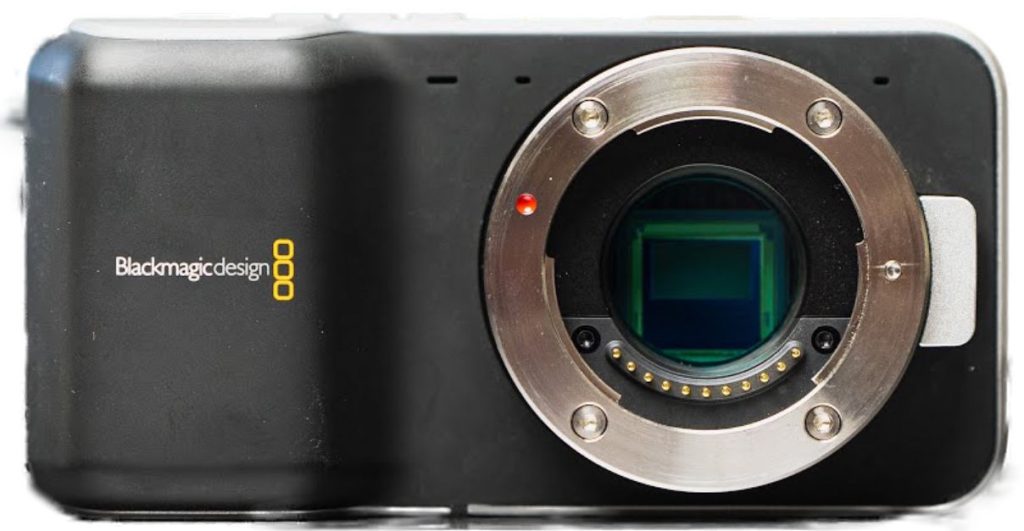
OK, so you might see that as a problem, but, in fact, it carries lots of advantages with it.
And, while we’re seeing problems, why not continue for a while in that vein by talking about the things about this camera that are a pain in the bum. And then, eventually, we can get on to why, despite all of that, it’s still a great camera to have.
Cons …
- For a start, its battery life is a joke. You’d better have a pocketful of fully charged replacements if you’re out and about. Fortunately, they’re readily available and as cheap as chips. Or you can easily plug in an external battery with more oomph — again, they’re readily available. But that increases the overall size of your kit, of course.
- Its autofocus is unreliable and better avoided.
- It can run pretty hot (this is probably related to the first point above) — useful for keeping your hands warm on a cold winter’s day, and I’ve never known it shut down or fail due to overheating.
- There is no eye-level optical viewfinder — just a very large high-quality monitor screen on the back face of the camera. That’s excellent as far as it goes, but … you have to hold your head about a foot away from the camera in order to be able to focus your eyes on it, and, in bright sunlight, you’ll have difficulty in seeing it clearly unless you rig up some sort of shade.
- Its image format is a 16×9 version of the old semi-professional film movie format Super-16 (12.48x 7.02 mm, that is a 14.32 mm diagonal on 16×9). So that’s a crop factor of 3 compared to lenses for a conventional full-frame 35mm film camera, whereas most other MFT-mount cameras will have a bigger sensor (a so-called four-thirds sensor) running at a crop factor of about 2. Thus, a lens with a 16.7 mm focal length on the original 1080p BMPCC will match the field of view of a 50mm lens on a full-frame 35mm camera, or a 25 mm lens on most MFT cameras. Clearly, this is a small image sensor, but remember it’s operating at 1080p HD, not UHD, so its image quality is fine for most applications. And, just to set sensor size in context, the “1-inch CMOS sensor” on the DJI vlogging camera Osmo Pocket 3 actually has a diagonal hardly bigger than the BMPCC (maybe 15.9 mm cf 14.3 mm)
Pros …
- It’s really small and light compared to most specialist video cameras. It’s significantly smaller than later BMPCC cameras (the 4K and 6K). You really can put it in your pocket, especially if you fit it with a low-profile 12mm semi-wide-angle lens. I’ve shot a whole wedding in this way.
- The Apple ProRes recording format gives the camera a dynamic range of up to 13 stops, so you don’t need to fuss about getting the exposure just right, even in very dim light. You’ll almost always be able to extract good quality footage from whatever you shoot. This is a very valuable property.
- Its MFT lens mount means you have access to a vast range of lenses, and all of them much cheaper and lighter and smaller than lenses with a bigger mount (there’s less glass!). So you don’t have to save up for months or years to buy each lens. This massively increases your creative possibilities. You can cheaply explore focal lengths from fisheye to long telephoto at a fraction of the equivalent cost for a full-frame camera.
- MFT lenses are normally designed for the MFT image format. The original BMPCC 1080p image format is smaller (see above). That means you’re not using the edges of the image that the lens is designed to deliver. And it’s at the edges that the image quality falls away (even with the highest quality lenses), so, overall, you’re getting better quality images than typical MFT cameras using the same lens (including the BMPCC 4K).
- It’s hard to believe, but you eventually get to like the restrictions imposed by this camera — you sort of feel you’re in control, and not the camera software. Back to basics!
Sensor size and depth of field (a cautionary note)
Sensor size does more than affect the crop factor in the field of view. It also indirectly affects the depth of field. That’s because a smaller sensor size will require a shorter focal length lens to cover the same field of view as a camera with a larger sensor. And the depth of field for a given f-number is linked to the longitudinal magnification of the lens. And the longitudinal magnification goes as the focal length squared. So a ‘standard’ lens on a conventional old-school 35mm film camera will have four times the longitudinal magnification of a lens with the same fov on a typical MFT camera, and nine times that of the equivalent fov lens on a BMPCC original. so, if those three camera:lens combinations are all working at the same relative aperture (say f/2), the image formed by the 50mm lens on the 35mm film camera might show a lovely shallow depth of field, whereas the equivalent 17mm lens on the original BMPCC might show the whole object depth in reasonable focus. This effect is always present. Unless the image is processed to imitate shallow depth of field, it’s even worse for phone cameras, which typically have a “1x” fov roughly equivalent to a 25mm lens on a 35mm camera. So big cameras still have their place if you’re looking for shallow depth of field.
