Einstein aperiodic monotile
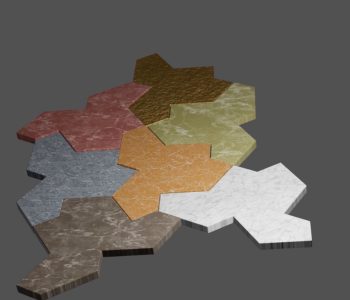
Listen, this is interesting, I promise. Gimme a chance — press the play button in the 8-second video above and then read on …
The story of the Einstein aperiodic monotile ended in 2023, but it began over 6,000 years ago with the ancient Sumerians (living in what is now southern Iraq), and, by the way, it has nothing to do with Albert Einstein. As far as we know, the great man was never interesting in tiling — the name is no more than a clever pun on the literal translation of his German name: ein Stein = one stone. You’ll see why in a minute.
Now the Sumerians had the clever idea (still popular today — your own bathroom is probably a good example) of covering walls with close-fitting baked clay tiles, and they immediately found that life was so much easier if they used a single shape and size of tile, so every tile was identical. They found that square and rectangular tiles were particularly convenient, but equilateral triangles also worked, as did regular hexagons. If you use only one shape of tile, it is called a monotile pattern.
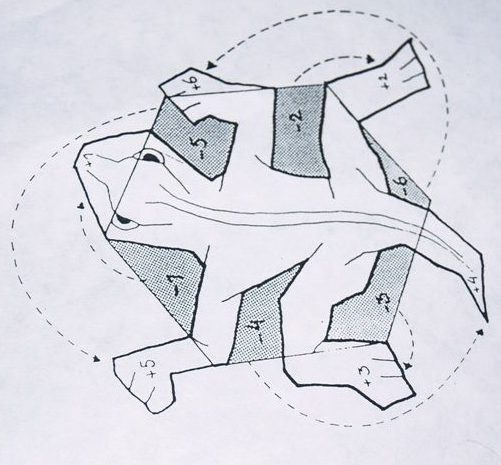
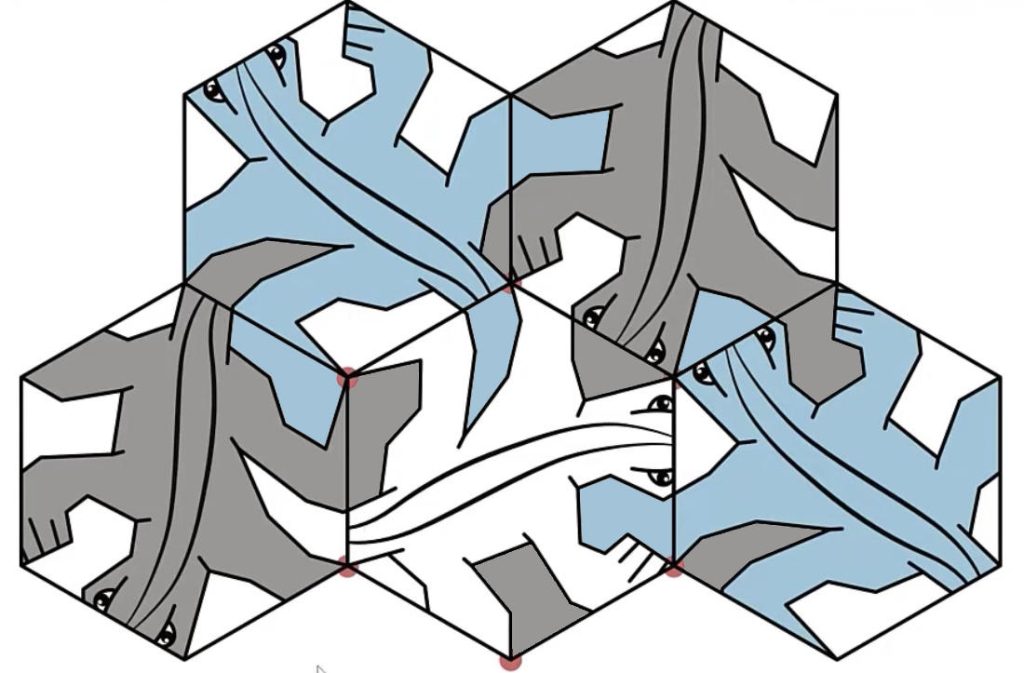
The geometrical artist MC Escher created many monotile patterns that were not simple geometric shapes. This image shows his lizard tessellation based on a cleverly modified hexagonal grid, whereby he cuts bits out of the original hexagon (shaded) and rotates them around a chosen vertex of the hexagon (see his arrows in the adjoining diagram) and sticks them down again.
Thus the tessellated hexagons simultaneously produce a tessellated pattern of lizards. The six vertices of the original hexagon lie at the lizard’s left jaw, its right little finger, its right knee, on the right side of its tail, its left heel, and its left elbow. The lizards lie in three different orientations with their heads meeting near the left eye.
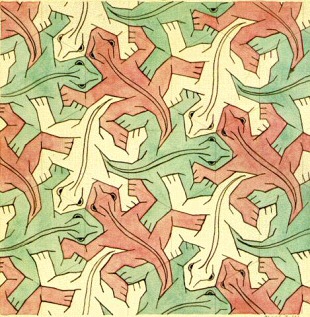
Note that the pattern is still periodic (ie it has a group of tiles that can be repeated to create the overall pattern).
But the search was still on for a single tile shape (a monotile, ein Stein = one stone) that could be used to create an aperiodic pattern (one that did not periodically repeat and did not contain arbitrarily large periodic patches)
No one could find a tile shape, whether a regular polygon or otherwise, that could aperiodically tessellate a flat surface without leaving any gaps.
In the 1970s Penrose almost got there by producing an aperiodic tessellation using two rhombus shapes: thin and thick, and with that — phew, the search for any solutions to the ein Stein problem was more or less abandoned by professional mathematicians. It was probably impossible if Penrose couldn’t do it.
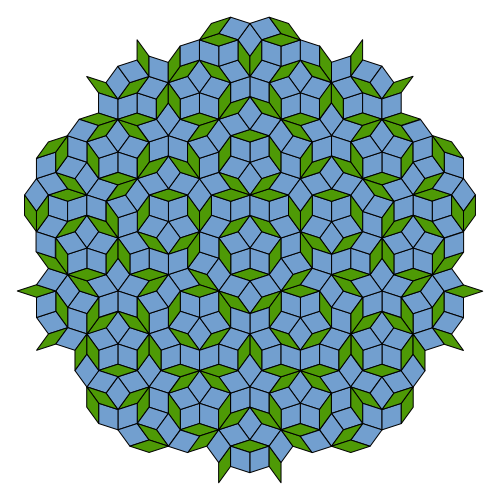
The Penrose aperiodic 2-tile tessellation.
The shapes are two rhombi: thin and thick. This work was acknowledged in the award of the 2011 Nobel Prize for Chemistry to Dan Schechtman as having paved the way to the understanding of quasicrystals
But, out of the blue. in 2022, David Smith, a retired print technician from Yorkshire with a purely amateur interest in maths came up with a 13-sided irregular polygon that could be perfectly tessellated. He called it ‘the hat’. This is the shape shown in the video at the top of this page.
Moreover, after he recruited the support of three distinguished mathematicians (Craig S Kaplan, Joseph S Myers and Chaim Goodman-Strauss), it was proved that the pattern is truly aperiodic or non-repeating, meaning that you can never find a basic chunk of the pattern which, when replicated and moved sideways or up and down, will enable you to create an exactly fitting larger version of the pattern. In crystallographic terms, there is no unit cell.
The verified result was published in 2023 and, in the ensuing press acclaim, FA Publications was among many to be invited to produce a Blender-created short movie showing the new tile in action. (Blender is a powerful computer-based 3D animation platform.)
In the video, note that the olive coloured tile has to be flipped over to complete the tessellation. So if these were commercial bathroom tiles all of the same production run, they would have to be of finished quality on both sides.
Aperiodic tessellation is the basis of research into quasicrystals which it is hoped will have applications is the design of novel strong materials.
And that brings a 6,000 year old story up to date.